All-in-One Website Service vs Hiring Separately: What Small Businesses Need to Know
All-in-one website service vs hiring separate agencies: compare real UK costs, coordination risks, and SEO performance — then use our checklist to decide.
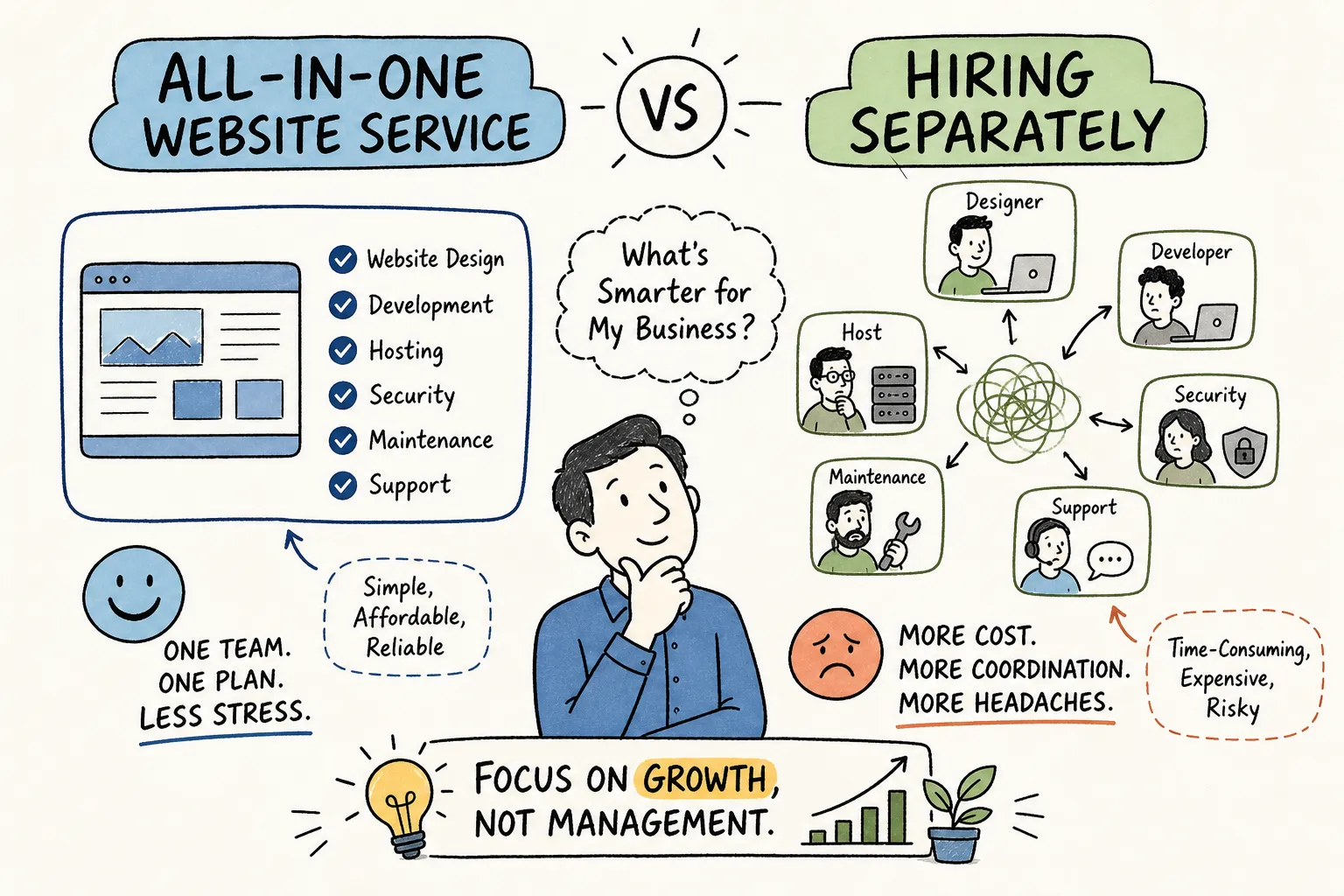
Many small business owners don’t set out to compare an all-in-one website service versus hiring separate web design and SEO agencies, it just happens. You need a website, so you find a web designer. They don’t handle hosting, so you set up an account with a hosting company. Six months later, your site isn’t showing up on Google, so you bring in an SEO agency. Suddenly you’re managing three relationships, three invoices, and three different teams who each have a perfectly reasonable explanation for why results are slow.
This fragmented approach isn’t a niche problem. It’s the default path many businesses stumble into without realising there’s a cleaner alternative. The real question isn’t whether you need great web design and SEO working together, you absolutely do. The question is whether you’re better off buying them under one roof or assembling your own team of specialists.
This article gives you an honest comparison: real UK costs, the coordination risks that rarely appear in proposals, performance differences backed by data, and the specific scenarios where each model genuinely wins. By the end, you’ll have a short list of questions to ask any provider before you commit, whether that’s a fully managed service or a pair of independent specialists.
All-in-One Website Service vs Hiring Separate Web Design and SEO Agencies, Cost Breakdown
The numbers that rarely appear in one place: hiring a web design agency in the UK typically costs between £4,000 and £10,000 for the build alone, based on widely reported UK agency pricing data. Add a professional SEO retainer (£1,500, £4,500 per month) and managed hosting (£50, £200 per month), and your first-year total can reach anywhere from £22,000 to £64,000. A full-service package covering design, hosting, SEO, and ongoing maintenance typically runs £3,000, £6,000 upfront with £1,000, £2,500 per month combined, putting the first-year cost at roughly £15,000, £35,000.
The separate route costs more for structural reasons that don’t show up in individual proposals. You’re paying duplicated project management fees, two sets of onboarding costs, and almost certainly a bill from your SEO agency to re-audit and fix technical issues the web designer didn’t prioritise. Web agencies routinely promise an “SEO-ready” site at handover. In practice, this usually means clean URLs and a meta description field, not a site architecture actually shaped by keyword research and crawlability requirements. The cost of closing that gap post-launch catches most clients off guard, and it’s one of the main reasons hiring separately runs 20, 40% more expensive than an integrated package over the first year.
The Coordination Trap: Why Two Vendors Create Three Problems
When your site is slow, who fixes it? The web agency says the site was fine at handover. The SEO agency says it’s a hosting issue. Hosting says the code is bloated. Every email exchange costs you time, and rankings keep slipping quietly while the vendors negotiate accountability. This is a common outcome when design and SEO are handled by different providers with no shared brief and no shared stake in the result.
The technical conflicts are specific and predictable. Designers prioritise visual impact; they’ll use autoplay media, heavy hero sections, and content tucked behind tabs or accordions. Each of those choices directly undermines Core Web Vitals scores (LCP, INP, and CLS), breaks heading hierarchies that search engines rely on, and hides content from crawlers. An SEO agency inheriting that site has to unpick decisions made before they were involved, billing for work that wouldn’t exist if both disciplines had shared a brief from the start. These are examples of common web design issues that harm both user experience and SEO.
There’s also a cost that doesn’t appear on any invoice: your time as the unofficial project manager. Briefing two agencies, chasing conflicting updates, translating technical disputes you weren’t hired to understand, and making decisions between competing recommendations takes hours every week. For a small business owner, those are hours not spent serving customers or building the business. Framing vendor management as a minor admin task consistently underestimates what it costs in practice.
Why SEO Built into the Site Outperforms SEO Added Afterwards
When an SEO agency inherits a site they had no hand in building, the first few months of their retainer aren’t spent improving your rankings. They’re spent fixing the foundation. That means a second technical audit to find what the designer missed, restructuring heading hierarchies, reworking image optimisation, and often rebuilding site architecture to make key pages properly crawlable. Each of these is a billable task that simply wouldn’t exist if SEO strategy had shaped the build from day one. This is exactly why many experts argue why website design and SEO should be done together rather than as sequential tasks.
The performance difference is meaningful. In documented cases, websites built with integrated SEO from the discovery stage have achieved page-one rankings for low-competition terms within 4, 12 weeks. Sites that launch without that foundation and bring in a separate SEO agency afterwards typically spend the first 1, 2 months in a catch-up phase before any optimisation work can begin. In one documented case study tracking 80+ client websites, researchers reported a 200% increase in indexed keywords where the technical foundation was established correctly pre-launch, compared with sites where SEO was retrofitted later. For further reading on timing and the impact of starting SEO early, see this discussion on SEO for websites before or after launch.
SEO is a design constraint, not an afterthought. Site architecture, internal linking, page structure, and load performance are all decisions made during the build. Treating them as something to address after launch doesn’t just slow down results, it creates double work, extra cost, and a ranking timeline that starts from behind rather than from a clean foundation.
When Separate Specialists Genuinely Make Sense
Separate specialists do outperform in specific, well-defined situations. Consider a national brand with a significant SEO budget (£3,000 or more per month), an enterprise-level business needing custom development well beyond a standard CMS, or a company with an internal marketing manager who can coordinate two agency relationships without it consuming most of their week. In these cases, the depth of a pure-play SEO agency combined with a dedicated development studio can deliver sharper results than a generalist provider. If you need deep technical SEO expertise, consult listings of best technical SEO agencies to find specialists experienced with large-scale indexation and crawlability challenges.
The key variables are budget, internal resource, and project complexity. If you have the team to manage two vendors, the budget to invest at a level where specialism pays off, and clearly defined channels you’re already performing in, specialists can deliver more depth per discipline. A hybrid model also works well: one integrated partner leading the overall strategy while a specialist is brought in for a narrow, specific task.
Most small UK service businesses, however, don’t match that profile. A local plumber, a restaurant group, or an accountancy practice has a modest budget, no internal web resource, and a genuine need for someone who handles everything without needing to be managed. For that majority, the coordination overhead of two agencies is a liability. It demands exactly the kind of time and attention that small business owners don’t have, and it creates exactly the kind of accountability gap that produces slow results and surprise invoices.
What One Accountable Partner Actually Looks Like in Practice
A managed website service bundles design, hosting, maintenance, and SEO under a single monthly subscription. There’s one contract, one invoice, and one team that owns the outcome. When something breaks or rankings dip, a single call resolves it, no design agency to consult separately, no hosting ticket to raise in isolation, and no argument about whose responsibility the fix is. This is as much an operational decision as a financial one: predictable costs, no project management overhead, and proactive monitoring rather than reactive firefighting.
MozzTec operates this integrated model for small UK businesses. The plan covers custom web design and managed cloud hosting with SSL, CDN, daily backups, and uptime monitoring. On-page and technical SEO, plus proactive maintenance, are included as standard, no separate SEO retainer, no hosting contract held elsewhere, and no design agency that hands over a finished site and disappears. Critically, SEO strategy shapes the build architecture from the discovery stage. Keyword research, site structure, heading hierarchy, and Core Web Vitals targets are all built into the brief before a single page is designed. That’s the integrated approach that consistently delivers faster rankings and less rework.
What Clients Experience Day to Day
With a unified provider, issue resolution follows a single escalation path rather than a chain of vendor emails. Monthly reporting covers organic conversions alongside traffic, rather than vanity metrics alone, and the roadmap for the following quarter is driven by actual performance data rather than whichever vendor is most persistent. Verify SLA response and resolution times, reporting scope, and examples of client reports before signing with any provider, integrated or otherwise.
Questions to Ask Before You Sign with Any Provider
Before committing, ask for specifics rather than assurances. Demand organic conversion tracking, not just traffic numbers. Request named Core Web Vitals targets and a defined uptime SLA, for example, 99.9% with clear measurement methods and exclusions. Where PageSpeed scores are referenced, ask for measurable Core Web Vitals thresholds (LCP, INP, and CLS at the 75th percentile on mobile and desktop) rather than a single headline figure, since scores are influenced by third-party scripts and content changes that shift over time. Ask for a defined turnaround time for content and technical changes in writing: days, not “as soon as possible.” Monthly reporting should tell you what work was completed, not just what the numbers looked like.
The warning signs are equally clear. Walk away from any agency that can’t separate its design deliverables from its SEO deliverables in the proposal, if they can’t explain it clearly at the pitch stage, they won’t coordinate it effectively in practice. Avoid contracts with no performance clause or exit rights after a reasonable review period. Be wary of reporting that doesn’t filter bot traffic, since inflated visitor numbers obscure whether the site is actually generating enquiries.
The single most revealing question to ask any provider is this: how do you handle the handover between design and SEO internally? An integrated provider should have a clear, process-driven answer. A loose collection of separate vendors usually won’t.
When the All-in-One Website Service vs Hiring Separate Web Design and SEO Agencies Debate Gets Settled
If you have a lean team, a modest budget, and no appetite for managing vendor relationships, the all-in-one managed website service is the lower-risk, lower-cost, faster-to-results choice. If you’re running a larger operation with internal resource and deep per-channel budgets, separate specialists can deliver genuine depth. Both models work, the question is which one fits the business you’re actually running, not the one that sounds more sophisticated.
For most small UK service businesses, the maths and the operational reality point the same direction. Fragmented vendors produce fragmented results. A single point of contact, one predictable fee, and a build that integrates SEO from day one consistently outperforms the assembled alternative on both cost and timeline.
If you’re weighing up your options, MozzTec offers a free SEO audit as a no-pressure starting point. It gives you a clear picture of where your current site stands and what a managed service would look like for your specific business. No obligation, no jargon, just a straight answer to whether the integrated model makes sense for you.